Speculating with Rhubarb: The Cargo of the Vrede

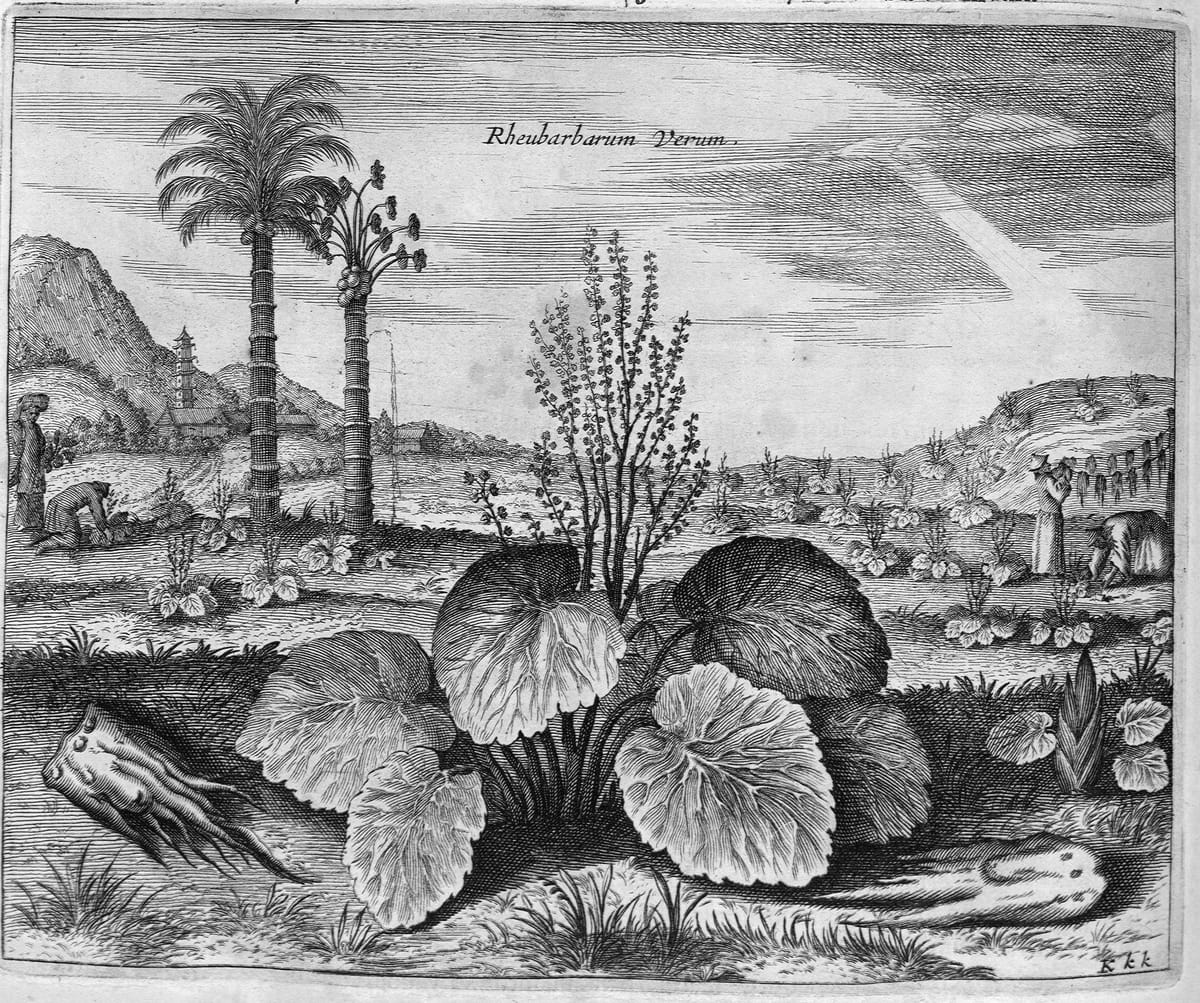
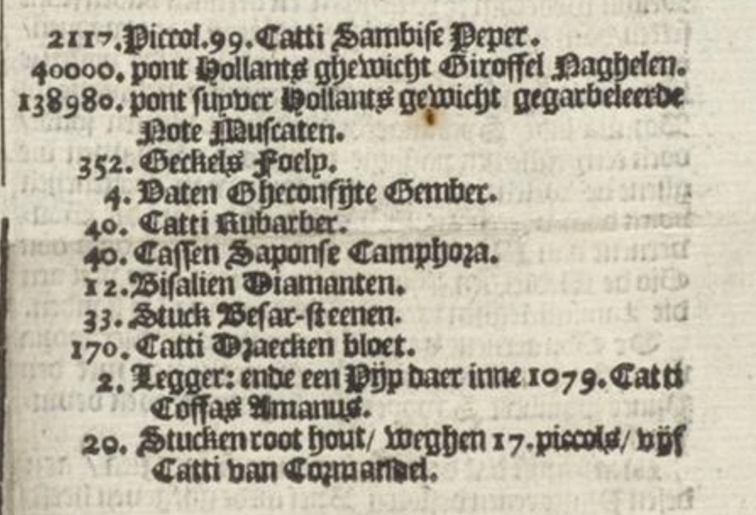
On the 23rd of February 1621, the Dutch newspaper Tijdinghe uyt verscheyde quartieren (news from different parts of the world) reported that a yacht named Vrede had returned safely to Zeeland from East India. It listed the full cargo understood to be aboard this ship, including pepper from Sambas (on Java), cloves, top-grade nutmeg and mace; vats filled with candied ginger and cases of camphor. The cargo also included diamonds, bezoar stones and ‘dragon’s blood’, as well as over 17 picul of redwood from the Coromandel Coast (See Fig 2).
The list includes several commodities we now cannot easily identify, such as the two ‘leggers’ and a pipe filled with 10,079 catty of ‘coffas amanus’. Several of the terms used to indicate the quantities of these goods are also unfamiliar now, such as the ‘geckels’ (‘sokkels’?) of mace or the ‘bisalien’ of diamonds. But as the linguists Marc van Oostendorp and Nicoline van der Sijs have argued, the so-called Golden Age of the Netherlands was a time of great linguistic change with an influx of new words that arrived together with goods and people from all over the world.[1] Newspapers like the one containing this cargo list, published from 1619 onwards in Amsterdam by Broer Jansz, played a key role not only in the circulation of news from all over the world but also in the integration of new words into the Dutch language.
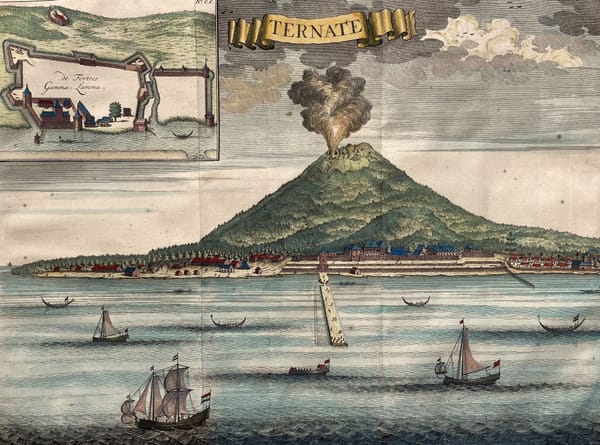
We know a little bit about the ship, known variously as Vrede, De Vreede, or De Goede Vrede, that carried this cargo into Zeeland. Built in Amsterdam in 1619, the Vrede only made two journeys to Asia. The first journey started on the 14th of September 1619 and ended when the ship returned to Zeeland in February 1621. The second started at the roadstead off the island of Texel in October 1621 and reached Pulicat via the Cape of Good Hope in May 1622. The ship then stayed in Asia, making several return journeys: from Surat to Gamron (now Bandar Abbas in Iran), from Batavia to Ternate (part of the Molucca Islands), Jambi (on the island of Sumatra) and Hirado in Japan between 1623 and 1627, and a final journey, again to Hirado, in 1628. Because relations between the VOC and the Japanese authorities were at an all-time low at that time, the Vrede was taken out of action and attached to chains in the bay. On the 10th of September 1631, a typhoon hit the coast of Japan, the chains broke, and the ship shattered as it hit the rocks.
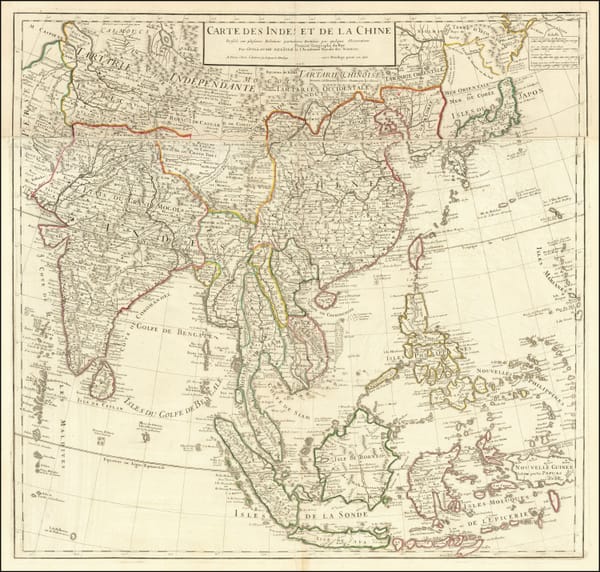
The cargo listed above was acquired on this first journey, about which we know much less. The ship sailed to Bantam, where she arrived after nearly nine months on 3 June 1620. On 31 July 1620, she set sail again from Jacatra, arriving in Masulipatnam on the Coromandel coast on the 3rd of October 1620 and reaching Zeeland on 4 February 1621.[2] The question is: did the ship acquire its cargo in Bantam during its stay there in June and July or in Masulipatnam in October 1620?
A letter written by the infamous Dutch naval officer and fourth governor-general of the Dutch East Indies Jan Pieterszoon Coen (1587-1629), sent to the Heren XVII by way of De Vrede in July 1620, provides some answers.[3] Pepper had been more difficult than usual to obtain from West Java due to ongoing local conflicts, but VOC ships sailing from Surabaya and Grissee (today’s Gresik) in East Java had brought the necessary supplies.[4] Coen also reports that ships conquered from their English rivals had brought 133,100 catty cloves from Ambon, 32,200 catty nutmeg and 350 sockel mace from Banda.[5] Coen reports of diamonds, too, in this letter: they had been obtained from Succadana on the island of Borneo, and Coen had immediately sent another ship back to Succadana to acquire more diamonds and bezoar stones.[6] The camphor is described as ‘Japanese’, so it must have been loaded on board in Jacatra. Ginger had previously been acquired from both Canton and Japan but was not always considered desirable enough to be shipped home and Coen made no mention of candied ginger in the 1620 letter.
That leaves several commodities that may or may not have been loaded onto De Vrede in Masulipatnam: the four vats of candied ginger, the ‘dragon’s blood’, the Coromandel redwood, and, last but not least, the 40 catty of rhubarb. In a letter dated January 1618, Coen had written that no further pieces of lacquer and porcelain would be sent home until further orders were received. Similarly, no further gum, rhubarb, ginger and silks would be purchased.[7] The reasons were mixed: in part, the problem was matching these new commodities to European market demand, but in part, the problem was related to the methods of packing the ships: when goods ‘dropped’ inside the hull, they arrived spoilt and could not be sold.
Could the rhubarb have been added to the cargo in Masulipatnam? The goods traded through Masulipatnam, located on the Coromandel Coast and now known as Machilipatnam in Adhra Pradesh, were often brought there by Persian traders. Rhubarb was acquired in Central Asia and traded through Silk Road cities like Samarkand and Bactria, and from there to Hormuz or via Golconda (now Hyderabad) to Masulipatnam. In the early seventeenth century, rhubarb was certainly not unknown: it had already appeared in widely read travel accounts, such as those by Marco Polo and Linschoten.[8] Throughout the eighteenth century, there was a lot of interest in the medicinal qualities of this root, especially its laxative qualities, and by the nineteenth century, rhubarb root was consumed in vast quantities in Europe; the annual London East India sale of 1805, for example, listed over 75,000 pounds of rhubarb for sale.[9] In the early decades of the seventeenth century, however, rhubarb was not yet well established in the medical repertoires, and it does not appear at all in the Generale Missieven of the VOC until 1639.[10] In that year, an attempt was made to sell a quantity of 2,771 pounds of rhubarb, for which over 9,000 guilders had been spent in Gamron, in the Dutch market.[11] The subsequent decision to sell rhubarb in Asia instead suggests that, in 1620, the Dutch market was not yet ready for this commodity.[12]
The cargo of De Vrede seems, thus, to have been a rather mixed bag. Some items were guaranteed to make a profit when the ship arrived in Zeeland in 1621, especially the pepper, nutmeg, mace and cloves. Surely, the bezoar stones and the diamonds would sell well. Other items were perhaps more speculative, such as the dragon’s blood or the coffas amanus, which would never make it into a well-established commodity. The rhubarb, it seems, arrived in the marketplace too early. Not long after, the medical establishment would become very enthusiastic about the many qualities of the rhubarb plant. But perhaps in the summer of 1621, Dutch digestive systems had no need yet of the laxative qualities that would make it so desirable later in the century.
[1] Marc van Oostendorp and Nicoline van der Sijs, ‘Een mooie mengelmoes’: meertaligheid in de Gouden Eeuw (Amsterdam: University Press, 2019).
[2] The city now known as Jakarta was first conquered and destroyed by the Dutch under Jan Pietrszoon Koen in 1619 and named Batavia in January 1621. See https://www.vocsite.nl/geschiedenis/handelsposten/batavia/, last consulted on 14 September 2026.
[3] Jan Pieterszoon Coen, Jan Pietersz. Coen, bescheiden omtrent zijn bedrijf in Indië, ed. H. T. Colenbrander and W. Ph. Coolhaas (’S-Gravenhage: M. Nijhoff, 1919), 560–84.
[4] Coen, Bescheiden, 561.
[5] Coen, Bescheiden, 563.
[6] Coen, Bescheiden, 572–73.
[7] Coen, Bescheiden, 315.
[8] Polo mentions rhubarb in chapter XL. Marco Polo, The Travels of Marco Polo., trans. R. E. Latham (Penguin Books, 1958); Jan Huygen van Linschoten, Itinerario, voyage, ofte schipvaert van Jan Huygen van Linschoten naer Oost ofte Portugaels Indien, 1579-1592, vol. 2, ed. Hendrik Kern (1596; ’S-Gravenhage M. Nijhoff, 1910), 36–37.
[9] William Milburn, Oriental Commerce, Containing a Geographical Description of the Principal Places in the East Indies (Black, Parry & Co., 1813), 2:517.
[10] W. Ph. Coolhaas, Generale missiven van gouverneurs-generaal en raden aan Heren XVII der Verenigde Oostindische Compagnie. Dl. II, 1639-1655 (Nijhoff, 1964), 31.
[11] Coolhaas, Generale missiven. Dl. II, 1639-1655, 32.
[12] Anne Gerritsen, ‘Seventeenth-Century Dutch Ventures in the Global Rhubarb Trade’, in Plants and Gardens as Artefacts in Transcultural Contexts: Between Asia and Europe, ed. Minna Törmä (Routledge, 2026), 26.